
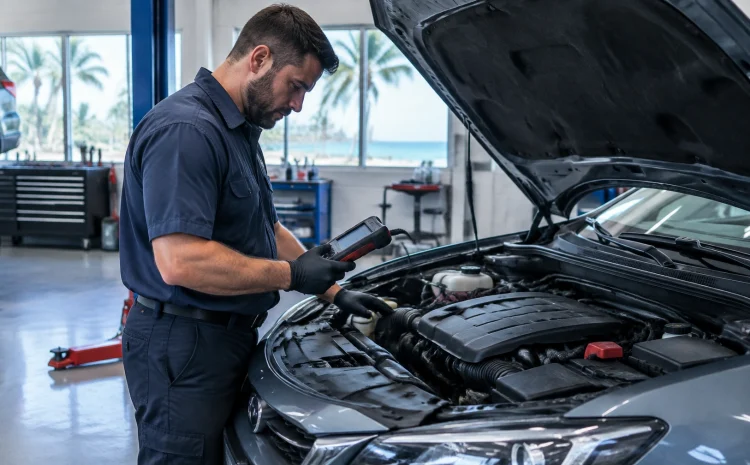
Why Does My Car Jerk When Accelerating? 6 Causes Explained
You press the gas to merge onto Highway 98, and your car suddenly stutters or bucks. It’s unsettling, and it can make you wonder whether it’s safe to keep driving.
Jerking during acceleration means something may be interrupting the engine’s power or the drivetrain’s ability to deliver it smoothly. The cause could be as simple as a restricted air filter or as serious as a misfire or transmission problem. The sensation alone can’t confirm which one it is.
Here are six common possibilities, what they may feel like, and why it’s worth having a persistent problem checked.
Why can worn or failing spark plugs make a car jerk?
Spark plugs ignite the air-fuel mixture inside your engine. When a plug is worn, dirty, or damaged, it may not fire consistently. That can cause an engine misfire, when one or more cylinders don’t produce power as they should.
You might feel a stumble or shake when you accelerate, along with rough idling, reduced power, or worse fuel economy. A bad ignition coil or related wiring can create similar symptoms, so a code or symptom doesn’t automatically mean the plugs are at fault.
Putting off a misfire diagnosis can make your car run poorly and, in some cases, allow unburned fuel to overheat and damage the catalytic converter. If the check engine light flashes while the car is jerking, pull over as soon as it’s safe and arrange help rather than continuing to drive.
Could a clogged fuel filter or failing fuel pump cause jerking?
Your engine needs a steady supply of fuel. A restricted fuel filter, if your vehicle has a serviceable one, or a weak fuel pump may struggle to keep up when you accelerate and fuel demand rises.
The car may hesitate, lose power on hills, or jerk more noticeably when you press the gas firmly. Difficult starting or stalling can also point to a fuel-delivery issue, though other problems can produce similar signs.
If the problem worsens, the vehicle may stall or struggle to accelerate when you need power to merge. A technician can test fuel pressure and delivery instead of replacing a pump based on guesswork. Filter locations and replacement schedules vary by vehicle, so check your owner’s manual or ask a technician before assuming yours is due.
Can dirty fuel injectors make acceleration feel uneven?
Fuel injectors deliver measured amounts of fuel to the engine. Deposits, wear, or an electrical fault can interfere with that delivery. If an injector sprays unevenly or doesn’t work properly, the engine may run roughly or hesitate under acceleration.
Other clues can include an uneven idle, a misfire, or reduced fuel economy. But these symptoms overlap with ignition and fuel-pressure problems, so an injector shouldn’t be replaced without testing.
Ignoring a confirmed injector issue can mean continued poor performance and, depending on the fault, added strain on other emissions components. Proper diagnosis helps identify whether cleaning, repair, or replacement is appropriate for your vehicle.
Can a faulty mass airflow or oxygen sensor cause a car to jerk?
The mass airflow (MAF) sensor measures incoming air so the engine computer can calculate how much fuel to deliver. An inaccurate reading can throw off that balance and lead to hesitation or jerking, particularly when you change throttle quickly.
The oxygen (O2) sensor monitors oxygen in the exhaust and helps the computer adjust the fuel mixture. A faulty sensor may contribute to rough running, sluggish response, or a warning light.
A diagnostic trouble code can identify a system or reading that needs attention, but it doesn’t prove that the sensor itself has failed. Wiring problems, air leaks, exhaust leaks, and other faults can affect sensor readings. Replacing parts before checking the cause can waste money and leave the original problem unfixed.
Could a worn CV joint, axle, or transmission be the problem?
Not every jerk starts in the engine. A worn CV joint or axle can cause a shudder or vibration that’s most noticeable while accelerating. A clicking sound while turning, a torn CV boot, or grease around the wheel area may provide additional clues.
Transmission problems may feel different. You might notice a jerk during a gear change, delayed engagement, slipping, or engine RPM rising without a matching increase in speed. Low, old, overheated, or incorrect transmission fluid may contribute to some issues, but the right fluid and checking procedure depend on the vehicle, especially on models with a CVT.
A severe clunk, grinding noise, rapidly worsening vibration, or loss of drive calls for prompt attention. Continuing to drive with a serious axle or transmission fault can make the damage worse and may leave you without reliable power.
For general transmission maintenance information, see Consumer Reports’ guide to transmission care.
Can a vacuum leak or clogged air filter cause hesitation?
A vacuum leak can let unmetered air into the engine, upsetting the air-fuel mixture. A split hose or loose intake connection may cause rough idling, a hissing sound, or hesitation when you press the accelerator.
A clogged engine air filter can restrict airflow and reduce performance, although it’s only one possible explanation for jerking. Filter condition, design, and replacement intervals vary by vehicle.
These checks are often straightforward, but don’t assume a cheap part is the answer. A smoke test and scan-data checks can help locate an air leak; a visual inspection can determine whether the filter or intake duct is blocked or damaged.

When should you stop driving a car that jerks?
If the jerking is severe, the engine is shaking, the vehicle stalls, or you notice smoke, overheating, a burning smell, or a loud clunk or grinding noise, stop somewhere safe and arrange an inspection or tow.
A flashing check engine light is also a reason to stop driving as soon as it’s safe. It can indicate a severe misfire that risks damaging the catalytic converter. A steady light with mild symptoms is different, but it still deserves prompt attention, especially if the problem affects your ability to accelerate predictably.
Even without a warning light, a recurring hesitation can become a safety concern in stop-and-go traffic or when you’re trying to merge. A professional diagnostic can help distinguish between engine, fuel, sensor, and drivetrain causes.
What should you do, and what should you avoid, if your car jerks?
Before your visit, note when the issue happens: cold or warm engine, low or high speed, uphill, while turning, or during a gear change. Pay attention to warning lights, sounds, smells, and whether the engine RPM changes. Those details can help narrow down the cause.
Avoid these common mistakes:
- Don’t keep accelerating hard to see if the symptom goes away.
- Don’t clear a warning code before it’s recorded and diagnosed.
- Don’t replace a sensor or other part based only on a code. A code is a clue, not a complete diagnosis.
- Don’t add transmission fluid or use a flush product without checking your vehicle’s specifications. The wrong fluid or procedure can create additional problems.
- Don’t ignore a flashing check engine light, severe vibration, or stalling.
At Express Tire & Auto Service, our ASE-certified technicians work on all makes and models. Our team brings over 20 years of dealership leadership experience and more than 50 years of combined expertise. We explain what we find, discuss the repair and pricing upfront, and don’t recommend replacing parts without a reason.
We’re a family-owned shop at 506 Navy Blvd, Panama City Beach, FL 32407. Walk-ins are welcome, and same-day service is available when possible. If your car is jerking and you’d like help figuring out why, contact us or stop by for a clear next step, and a little more peace of mind behind the wheel.