
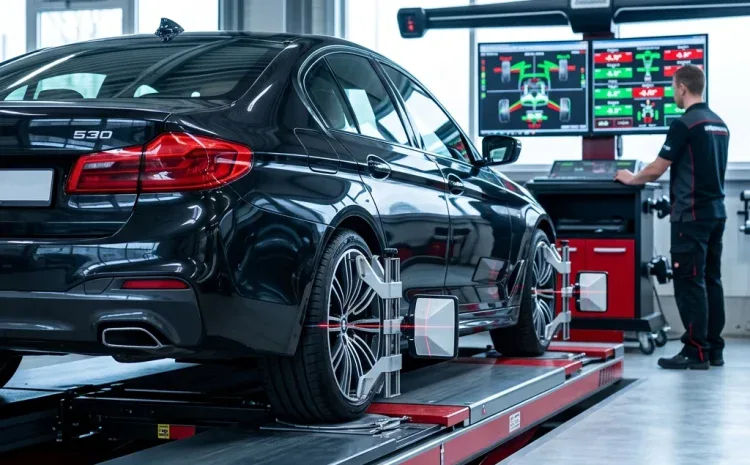
Wheel Alignment Matters: Why Your Car’s Safety Sensors Might Be Off
Have you ever been driving down Highway 98, perfectly centered in your lane, only to have your car suddenly “nudge” the steering wheel or beep at you to “stay in your lane”? It’s a jarring experience. You know you’re driving straight, but for some reason, your car thinks you’re drifting.
In the old days, a bad wheel alignment just meant your tires wore out faster or your steering wheel was slightly crooked. But today? Your car is essentially a high-powered computer on wheels. When your alignment is off, it doesn’t just affect your rubber; it confuses the “brain” of your vehicle.
At Express Tire & Auto Service, we’ve seen a massive shift in how we handle tires and alignment. It’s no longer just a mechanical adjustment, it’s a digital one. If your car’s safety sensors are acting up, the culprit might not be a broken computer, but a simple physical misalignment.
What Are These “Safety Sensors” Anyway?
Most modern vehicles (typically those made after 2012) are equipped with Advanced Driver Assistance Systems, or ADAS. These systems are designed to keep you safe by monitoring the environment around your car. They include features like:
- Lane Departure Warning (LDW): Alerts you if you drift out of your lane.
- Lane Keeping Assist (LKA): Actively steers you back into your lane.
- Adaptive Cruise Control (ACC): Maintains a safe distance from the car in front of you.
- Automatic Emergency Braking (AEB): Hits the brakes if it senses an imminent collision.
- Blind Spot Monitoring: Detects vehicles in your peripheral zones.
These systems rely on a network of cameras (usually behind the rearview mirror), radar sensors (often in the front grille), and ultrasonic sensors (in the bumpers). For these sensors to work, they have to know exactly where the car is pointed. This is what we call “Geometric Zero.”

Why Alignment is the Foundation of Safety Technology
Think of your car’s safety sensors like a pair of high-tech binoculars. If you’re trying to look at a distant sign but your glasses are slightly crooked on your face, everything will look blurry or off-center.
Your car’s sensors are “calibrated” to the vehicle’s centerline. When we perform a professional wheel alignment, we are ensuring that the wheels are perfectly square to each other and parallel to the road.
If your alignment is off, even by a fraction of a degree, the car’s physical direction of travel changes. However, the camera at the top of your windshield still thinks “straight” is where it was originally programmed. This creates a mismatch. Your car might think it’s drifting left when it’s actually going straight, causing the Lane Keeping Assist to fight you for control of the wheel.
The Secret Hero: The Steering Angle Sensor (SAS)
One of the most important parts of this puzzle is the Steering Angle Sensor (SAS). This sensor lives inside your steering column and tells your car’s computer exactly how much you are turning the wheel.
When your alignment is bad, you often have to “center” the steering wheel manually by holding it at an angle (maybe at the 11 o’clock or 1 o’clock position) just to keep the car going straight down the road.
Here is the problem: The SAS sees that the wheel is turned to the side. It thinks, “Hey, the driver is turning left!” Meanwhile, the stability control and camera systems see the car is moving straight. This data conflict can cause the car to disable safety features entirely, often popping up a “Service ADAS” or “Stability Control” light on your dashboard.
How Does Misalignment Happen in Panama City Beach?
We love living and working in the Florida Panhandle, but our roads can be tough on a car’s suspension. You might need an alignment check if you’ve dealt with:
- Potholes: Even a small one can knock your “toe” or “camber” out of spec.
- Curb Strikes: We’ve all been there: misjudging a tight turn at the grocery store.
- Worn Suspension Parts: Parts like tie rods and ball joints naturally wear down over time, especially with the salt air and humidity we deal with.
- New Tires: We always recommend an alignment check when you get new tires to protect your investment.
If you’re wondering if your issues are alignment-related or something else, you might find our guide on wheel alignment vs. balancing helpful for diagnosing that steering wheel shake.

4 Signs Your Safety Sensors are Off Because of Alignment
How do you know if your safety tech is struggling with a physical alignment issue? Watch for these red flags:
- The Steering Wheel is Off-Center: If you’re driving straight but the logo on your steering wheel is tilted, your sensors are getting the wrong data.
- “Ghost” Braking: Your Adaptive Cruise Control might suddenly slow down for no reason because it thinks a car in the next lane is actually directly in front of you.
- Late Warnings: Your Lane Departure Warning only goes off after you’ve already crossed the line, or it fails to trigger at all.
- Dashboard Warning Lights: If your ESC (Electronic Stability Control) or ABS lights are flickering, it’s often due to a Steering Angle Sensor that doesn’t match the wheel position.
Why a “Standard” Alignment Isn’t Always Enough
In the past, an alignment was a purely mechanical job. A technician would get under the car, turn some bolts, and look at a screen. Today, for vehicles with ADAS, we often have to perform a Safety Systems Alignment.
This process involves two steps:
- Mechanical Alignment: Setting the wheels to the manufacturer’s specifications.
- Electronic Calibration: Resetting the Steering Angle Sensor to “zero” and ensuring the cameras and radars are looking exactly where they should be.
At Express Tire & Auto Service, we take this seriously. We don’t just want your tires to last longer; we want your safety features to actually save you when you need them. If you’ve noticed your car acting a bit “twitchy,” it’s time to contact us for a check-up.
Common Mistakes: What Not to Do
When it comes to alignment and sensors, there are a few things you should avoid to keep your repair costs down and your safety up:
- Ignoring the Warning Lights: If your car tells you a safety system is disabled, don’t just “drive through it.” These systems are integrated into your brakes and steering.
- DIY Alignment: With modern sensors, the “string method” or “eyeballing it” just doesn’t work. You need precision equipment to satisfy the car’s computer.
- Replacing Sensors First: Don’t let a shop sell you a $500 camera or radar sensor until they’ve verified that the alignment is straight. Many “broken” sensors are just “confused” sensors.
- Skipping the Post-Repair Calibration: If you have general auto repairs done on your steering or suspension, you must recalibrate the sensors.

Trust the Experts at Express Tire & Auto Service
We know that car repairs can feel overwhelming, especially when “sensors” and “calibration” get brought up. Our goal is to be your transparent advisor. We’ll explain exactly what your car needs to be safe on the road, whether you’re commuting to work or taking the family to the beach.
Proper alignment is the foundation of a healthy vehicle. It saves you money on tires, improves your gas mileage, and most importantly, ensures that your car’s safety technology is working for you, not against you.
If your car feels a little “off,” or if those safety lights are giving you trouble, come see us. We’ll get your wheels pointed straight and your sensors back in sync, giving you the peace of mind you deserve.
Ready to get back on the straight and narrow?
Schedule your alignment today at Express Tire & Auto Service!